





How a hotel can use surveys to increase guest satisfaction and bookings
A survey is one of the cheapest and at the same time most powerful tools a hotel has. It does two things at once. It tells you how satisfied the guests you have right now are, and at the same time it shows you who you could have. In this article, you'll learn how to collect feedback from guests during and after their stay, how to use surveys to capture trends and behavior of potential guests, and how to turn this data into the basis for concrete decisions that will lift both satisfaction and occupancy.

When a guest checks out of a hotel, it usually looks the same. They smile at reception, say everything was fine, and wish you a nice day. The staff feel good — the stay went without a hitch. Then a few hours later, a review pops up online saying something quite different. Breakfast ended earlier than the guest expected. The room was noisy. The air conditioning didn't work properly at night. This isn't an exception. This is the standard.
The second group of people, who are crucial to a hotel's revenue growth, often stays completely off the radar. These are the people who looked at your hotel, considered it, compared it to the competition — and ultimately chose somewhere else. The hotel only knows that they didn't show up. And yet there are surprisingly many reasons behind it, often subtle ones. It's not just about price, as hotels often assume. A guest's decision-making is much more complex, and most of these factors stay invisible without feedback. Often, it's not just the room itself that decides — it's the whole picture of the stay. The kind of experience the guest pictures. It's not just where they'll sleep, but everything they'll experience during the stay. If a hotel doesn't offer wellness, a relaxation area, activities, or a program, it can come across as not enough — even if the rooms themselves are perfectly fine. A guest arriving for relaxation or a weekend experience easily picks the competitor that, alongside accommodation, also offers a hot tub, saunas, massages, or a clear stay program. Another common reason people don't complete a booking is the decision-making process on the website itself. Sometimes a guest simply can't find their way around, didn't quickly find what they were looking for, or isn't sure what they're actually getting. The photos don't feel trustworthy enough, room details are missing, it isn't clear what the bathroom looks like or what the actual standard of the accommodation is. At other times, basic information is missing — whether breakfast is included, how parking works, how far the hotel is from the centre, or exactly when breakfast starts and ends. They are small details, but at this moment they often decide whether the guest finishes the booking or sets it aside and opens a competitor's offer.
We also shouldn't overlook the fact that trust plays a big role. If a hotel doesn't have enough reviews, or they look bad at first glance, the guest prefers to play it safe elsewhere.

What a hotel learns from surveys
Three reasons to make surveys a permanent part of operations:
A satisfied guest comes back and costs a fraction of acquiring a new one. Acquisition costs in hospitality keep rising long-term, whether through OTA commissions, performance campaigns, or destination marketing. A guest who returns to you costs a fraction of what you'd spend acquiring a new one. A post-stay survey tells you what made the difference for satisfaction — and what to maintain or improve so they come back.
Silent dissatisfaction slips through your fingers. A guest who has a problem often won't let on at reception during check-out. If you ask whether everything was fine, you'll usually hear "yes." That accumulated frustration then leads them to the decision to write an unflattering review at home. A survey during the stay or right after captures exactly these signals at a moment when something can still be done about them. A lot of people are willing to share their opinion through a survey because it's easy and conflict-free for them. They say what they think without having to handle it in person or explain anything in detail. In case of dissatisfaction, hotel staff can react immediately — even during the guest's stay. That gives them the chance not only to explain the situation, but above all to actively put it right before it turns into a negative review or a spoiled overall impression.
A survey is the cheapest market research. Not every survey has to go to your hotel guests. You can also ask people who only looked at your hotel and didn't book, or people in the target segments you'd like to reach more of. You'll find out what your hotel is missing to attract a new group, and where it makes sense to invest in new products, packages, or services.
1. Collecting feedback from existing guests
Feedback has the most value when it comes as close as possible to the moment the guest experienced what you're asking about. Asking a week after departure whether the air conditioning worked is too late — the guest no longer remembers details, only the overall feeling. In a hotel, there are several key points where it makes sense to ask.
After check-in
A short survey via a QR code in the room or an SMS with a single question — whether everything is fine so far — is enough. If the guest answers that it isn't, you still have several days of the stay to put it right. This is the most valuable moment, and one that most hotels don't make use of. Instead of a bad experience, the guest leaves with the feeling that you took care of it — and that they remember more strongly than the original problem.
The day before departure
A short survey with a question about satisfaction with breakfast, cleanliness, quiet in the room, or services. The goal is twofold: to catch shortcomings while you can still resolve them, and at the same time to let the guest know you care about their experience.
After departure
A classic post-stay survey 24–48 hours after departure.
The main NPS question ("Would you recommend our hotel to family or friends?") + CSAT for key areas (reception, room, breakfast, F&B, location). An open-ended question, "What could we improve?" — usually delivers the most valuable answers of all.
After a complaint
If a guest reported a problem at reception (broken air conditioning, noise, dirty room), send a short CES survey the day after it's resolved: "Was it easy to sort this out with us?" Guests whose problem the hotel solved quickly and professionally often end up with higher loyalty than those who had no problem at all.
Periodically with regular guests
For hotels where the same guests return — corporate clientele, spa guests, wellness guests — it makes sense to run a broader survey once a year. What works at your hotel, why they keep coming back, what they'd appreciate as new offerings, what package they'd buy. Suggestions from regular guests are often the most valuable product input you can get — and at the same time the foundation for new offers you can later test on a wider market.

2. Market research to improve hotel services
Who can the hotel ask
People who didn't complete the booking. If you're using your own booking system, you have email addresses of people who started filling out the form but didn't finish — you can send them a short survey a few days later with a single question: "What made you decide not to book the room in the end?" A short survey a few days later can reveal price barriers, missing information, or weak trust in the hotel.
Website visitors who didn't book. A pop-up exit-intent survey on the booking page: "What's stopping you from booking?" Same principle, just a wider sample. It shows you where the website fails to convince the visitor that this is the right hotel. The decision can be missing photos, information about breakfast or parking, or simply a price that's too high.
Your own mailing list / database of past guests. If you have 5,000 people in your database, that's a huge source of information about your target market. Use surveys to find out what they'd appreciate during their stay.
Target segments you don't know yet. If you want to break into a specific market — international clientele, families with small children, B2B clientele — it's worth running a survey within the target group. What they expect from a hotel, what package would speak to them, how they decide on a destination.
What the hotel gains
Market research surveys answer questions your own guests can't. Instead of just reacting to current needs, the hotel gets the input for what to do in the future:
- which trends are coming
- what packages and services the market wants
- which hotel is beating you and why
- which segment makes sense to target next
Key metrics: NPS®, CSAT, CES
Three standard metrics, each measuring something different. You don't have to track all three at once, but you should know what each one tells you.
NPS® – Net Promoter Score
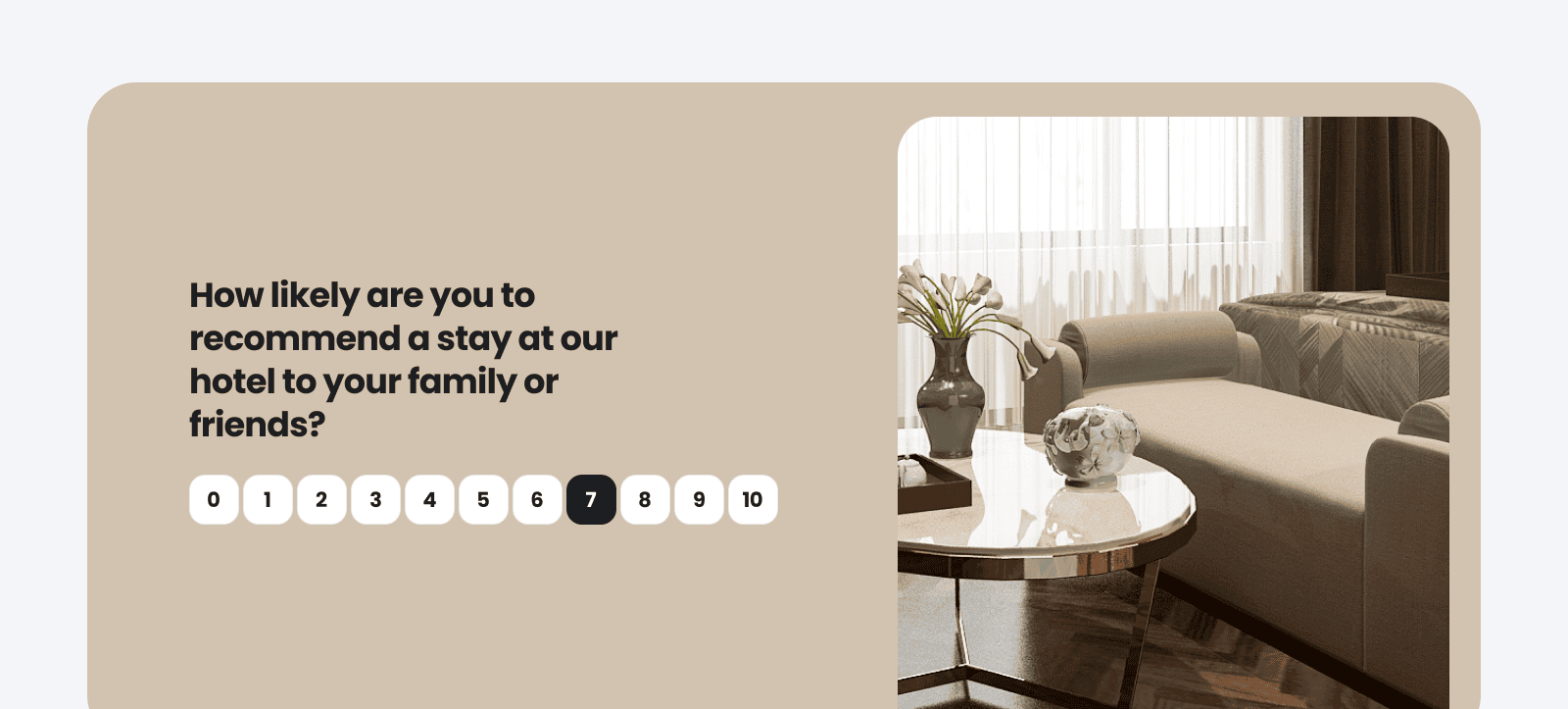
Question: How likely are you to recommend our hotel to family or friends?
NPS® measures loyalty and willingness to recommend. Calculation: percentage of promoters (9–10) minus percentage of detractors (0–6). The result is a number between −100 and +100. In hospitality, it's sent 24–48 hours after departure as the main summary indicator. More important than the absolute value is the trend — a drop from 45 to 30 between seasons is a more serious signal than an absolute value of 30. Send detractors a follow-up question: "What would we have to change for you to recommend us?" The answers are the most valuable data you'll get from your surveys.
CSAT – Customer Satisfaction Score
Question: How satisfied are you with [a specific area]?
CSAT measures satisfaction with one specific thing (breakfast, cleanliness, reception, wellness, F&B). Calculation: percentage of 4 and 5 ratings out of total. A value of 80% and above is a good standard, below 70% is a signal to act. The strength of CSAT lies in its specificity. When you have CSAT for breakfast at 70% and CSAT for rooms at 92%, you know which department to prioritize.
CES – Customer Effort Score
Question: Was it easy to complete online check-in / resolve a complaint / book a room?
CES measures how much effort the guest had to spend. It's based on research showing that reducing customer effort has a bigger impact on loyalty than aiming for an "exceptional experience." In a hotel, CES makes sense after online check-in, after a complaint, and on web bookings.
When to use which metric
NPS® as the main summary indicator after departure. CSAT for specific areas where you want to know where to focus improvement. CES where you're addressing effort and friction (booking, check-in, complaints). In practice, in a hotel it's usually enough to combine NPS + 4–6 CSAT questions on key areas.
What to do with the data
Collecting data is easy. Let's look at a few principles for working with it:
Categorize responses. Split open-ended answers into categories (breakfast, noise, cleanliness, reception, technical issues, location, value for money). When 30% of complaints point to noise, you have a clear priority. It's no longer about individual guests, but about a systemic problem.
Connect the data with departments. CSAT on breakfast goes to the F&B manager, CSAT on rooms to housekeeping, CSAT on reception to front office. Each gets their slice of the data and their own responsibility.
Close the loop with the guest. When a guest gave a low rating and wrote you something, get back to them. These guests are often convertible back to satisfied — and either way, they'll see that feedback leads somewhere. Some of them will return.
Report monthly. NPS® development, CSAT for key areas, top 3 complaints, market research results. Without a monthly report, feedback won't go anywhere — it will stay as an unprocessed pile of data.
Three most common mistakes in collecting hotel feedback
You ask only after departure. That's the moment when it's already too late to put anything right. The guest who wrote in your survey that there was noise from the street wrote the same thing publicly. If you'd asked on the first evening, you could have offered them a room at the back and shaped their entire stay experience.
You only watch the average. NPS® 30 or CSAT 80% can mean different things. Always look at the distribution and at the development over time.
You only ask guests who already stayed. This way you cut yourself off from potential opportunities. You won't learn from your guest surveys why others don't show up or pick the competition — and yet that's the key to growing occupancy.
Start measuring guest feedback with SentiSnap
A survey isn't about having a long list of complaints. It's about having a system that regularly shows you where your hotel is losing satisfaction and where it has room to grow. In SentiSnap, you set up surveys for every point of the guest journey. Collect feedback after check-in, the day before departure, post-stay, after a complaint — and at the same time run market research surveys among potential guests. Everything in one place, answers in real time. Start for free and find out what your guests and your market are really telling you.

Lucie Smejkalova
Lucie has been helping companies better understand their customers and target audiences for over 5 years. She enjoys analyzing feedback from social media, media, and surveys. In her articles, she shows how to turn data into useful insights and how to make better decisions based on feedback.
